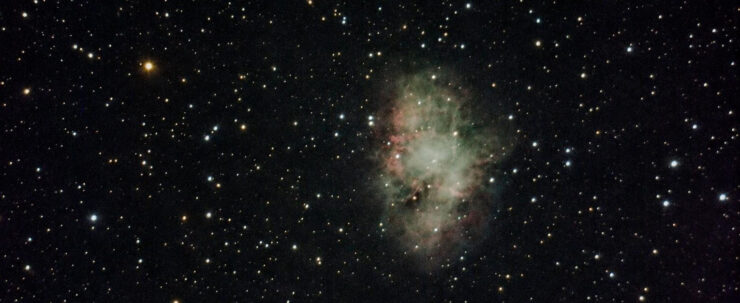
On July 4, 1054, Chinese astronomers discovered a new star in the daytime sky. It was an exploding star (supernova) that shone as brightly as Venus and is also mentioned in European records. The star’s outer material was hurled into space, and today we see it as an irregular cloud known as the Crab Nebula in the constellation Taurus (catalog number Messier 1).
Our 14-year-old observatory colleague Jamie Schmermbeck took on this challenging astrophotography project and captured it with a great deal of patience, technical know-how, and enthusiasm for astronomy. It was quite chilly at our student observatory, but Jamie proved to be quite resilient to the cold. It is particularly noteworthy that Jamie has been tackling the technical challenges of deep-sky astrophotography from a young age. From selecting the equipment to precise guiding and the actual exposure, a project like this requires a great deal of knowledge, perseverance, and passion. With this project, Jamie impressively demonstrates what is possible with a passion for astronomy, the right equipment, and plenty of patience.
Exposure details at a glance:
- Telescope: Celestron C11
- Imaging camera: Astro-modified Canon EOS 600D
- Guiding camera: ZWO ASI120MC
- Total exposure time: Just under 3 hours
- Individual exposure time: 180 seconds
Image: Jamie Schmermbeck, Text: Jamie Schmermbeck & Thomas Eversberg


Add comment