The James Webb Space Telescope: more than spectacular!
Prof. Dr. Uli Klein
Argelander Institute for Astronomy at the University of Bonn
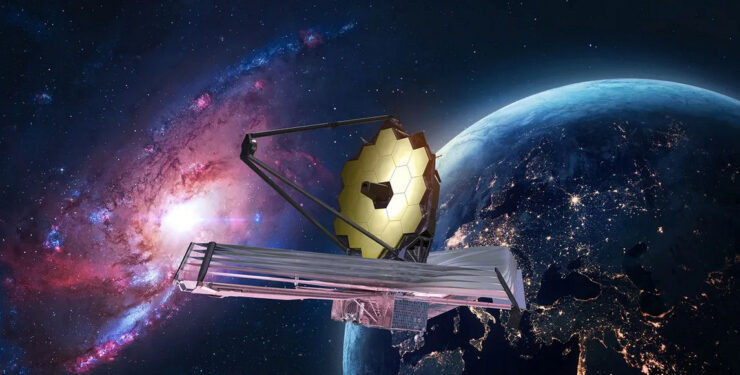
Launched on Boxing Day 2021, the space telescope has not only met expectations after three years of operation, but has exceeded them in many respects. As the successor to the Hubble Space Telescope (HST), it has delivered one spectacular result after another since it began operating. However, its cameras operate in the near-infrared (NIR) range, which means that the telescope is breaking new ground in two ways: First, good NIR observations have been virtually impossible until now (observations must be made from outside the Earth’s atmosphere). With the HST, it is possible to work at distances of up to 13 billion light-years, whereas the JWST’s NIR cameras can theoretically reach as far as the first stars and galaxies: the redshift thus shows galaxies in the classical optical range!
Prof. Klein describes the extremely difficult construction, the ‘packaging’ in the Ariane 5, the flight to the Lagrange point 1.4 million km from Earth, its deployment on the way there, its difficult commissioning, and, of course, the breathtaking results that followed. The audience will be taken on a journey into the vastness of space with spectacular images taken through a ‘telephoto lens’ with a focal length of 131.4 m!
Afterwards, there will be an opportunity for a question and answer session and a guided tour of the observatory.
- When: Friday, March 6, 2026, 7:00 p.m.
- Where: Waldbröl-Schnörringen Student Observatory, Ringweg 8a, 51545 Waldbröl
- What: A lecture on the James Webb Space Telescope
- Admission: Free – generous donations are requested
- Registration: Required at [email protected] (please provide names and number of people)
Due to clear emergency routes at the observatory, parking is only available in the village of Schnörringen.
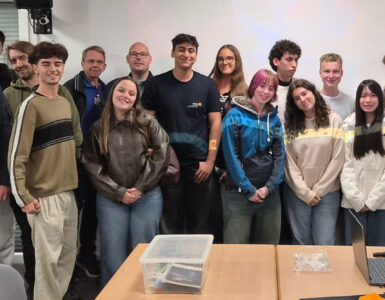


[…] Vortragsabend in der Sternwarte […]